Xarel·lo: the grape that holds Penedès together
It gives cava its body, it ages best, and for decades nobody wanted to bottle it on its own. A portrait of the variety that is most ours.
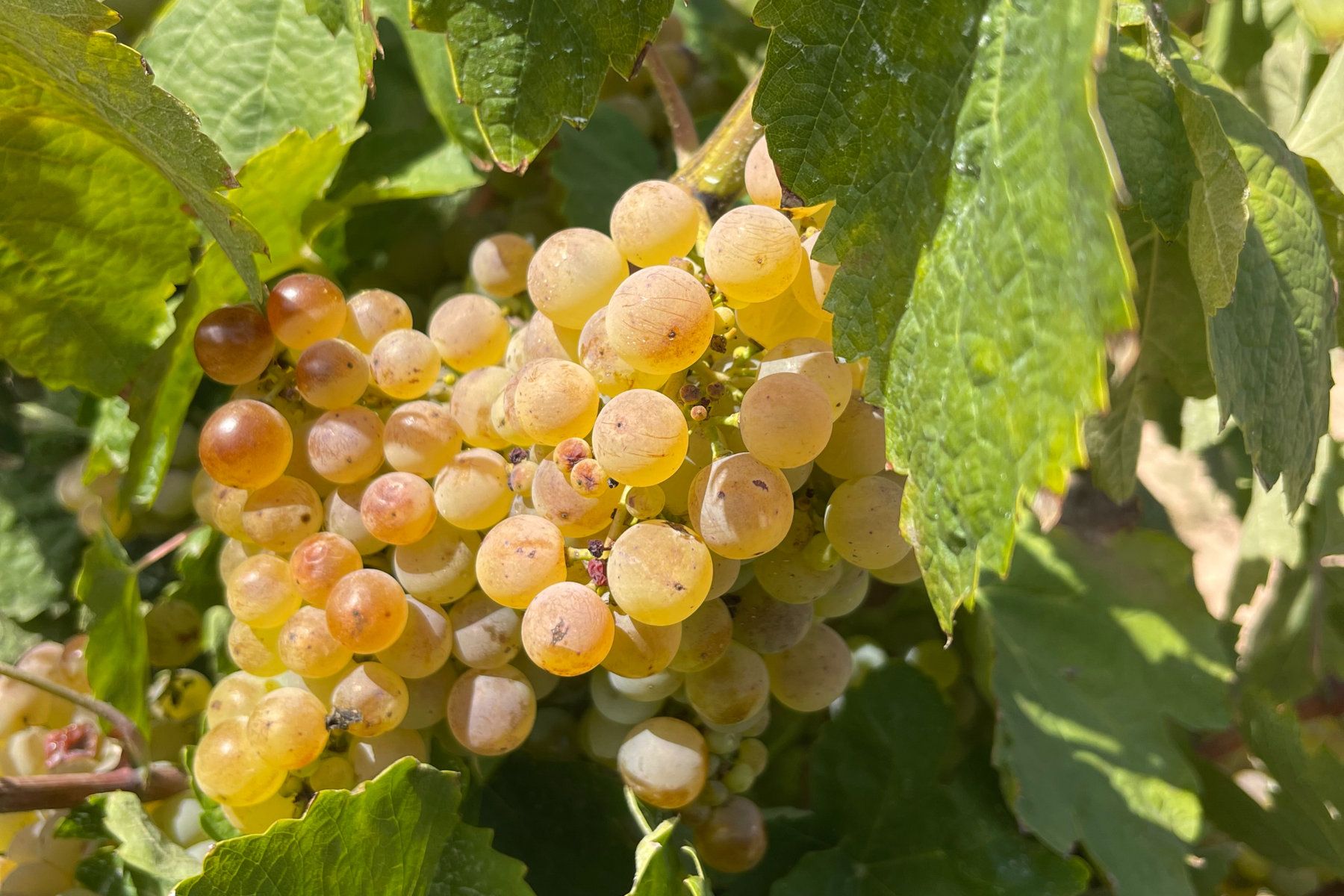
If you had to pick a single grape to explain Penedès, this would be it. Not the most aromatic, nor the easiest: the one that endures.
A vine that copes with heat
Xarel·lo buds late and ripens in mid-September, right as the heat starts to ease. It has thick skin and small berries, which makes it resistant to drought and to powdery mildew. In a county that runs shorter on water every summer, that has stopped being a technical footnote and become the reason we can still plant it.
Our oldest Xarel·lo vines are close to fifty-five years old. They yield little — perhaps half what a young vine gives — but the must carries a concentration you cannot reach any other way.
What it brings to the blend
In cava, the classic trio divides the labour:
- Macabeu brings the fruit and the easy charm.
- Parellada brings finesse and floral aromatics.
- Xarel·lo brings body, structure and the acidity that lets a bottle spend years on its lees.
Without Xarel·lo, a long-aged cava goes flat. It is the backbone: not the part you notice most on the first sip, but the part still standing at the end.
The shift of the last twenty years
For decades Xarel·lo was a blending grape. Nobody bottled it alone because it was considered too harsh, too bitter. It took a generation of growers digging their heels in to discover that the problem was not the variety but the yields: pushed hard, it gives a short, green wine; kept lean, it gives a broad white with an almost waxy texture and a noble bitterness at the finish that recalls almond.
That is the wine you will find in our Vi Blanc Premium Ecològic, made only from old-vine Xarel·lo and Macabeu.
How to spot it in the glass
Three fairly reliable signals:
- Colour with greenish reflections when young, turning golden quickly.
- Nose of apple, fennel and nuts. Barely floral, never tropical.
- Palate with a waxy, filling texture and a slightly bitter finish. That bitterness is not a fault: it is its signature.
Xarel·lo vermell, the odd cousin
There is a pink-skinned mutation, Xarel·lo vermell, now almost gone. We use it to make our Vita Vivet Orange Wine, macerated on the skins. It gives a pale orange wine with light tannin and an aromatic profile unlike anything else in the cellar.
To really taste it
The honest way to understand a grape is to drink it three ways in a row: as a young white, as a cava base and with ageing. We do exactly that on the Excel·lència Visit, where Xarel·lo turns up four times across eight glasses.